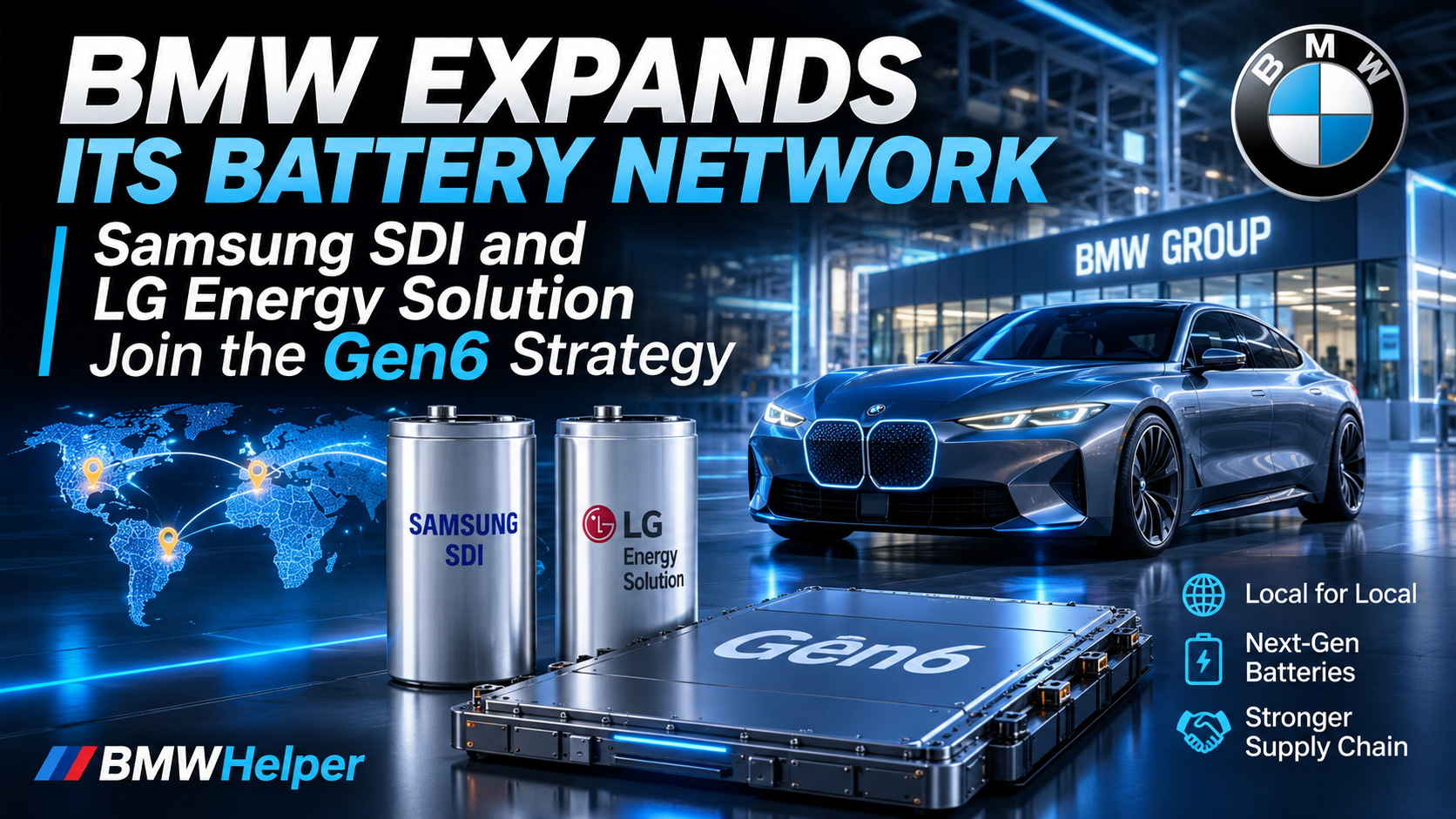
BMW Expands Its Battery Network: Samsung SDI and LG Energy Solution Join the Next Generation
Electric vehicles are becoming an increasingly important part of BMW's future, and the company is changing the way it approaches battery production. The challenge is no longer just developing more efficient batteries. It is also about building a reliable global network capable of manufacturing and supplying them.
On November 9, 2026, BMW Group announced an expansion of its battery cell supplier network. Two major South Korean manufacturers, Samsung SDI and LG Energy Solution, are joining BMW's existing partners. The new agreements are connected to BMW's sixth-generation battery technology, known as Gen6, which will power future electric vehicles.
Samsung SDI will supply battery cells for BMW's European operations, while LG Energy Solution will serve the US market. Deliveries are expected to begin in the late 2020s, using the companies' existing production facilities in their respective regions.
Why does BMW need additional battery suppliers?
The battery is one of the most expensive and technologically important components of an electric vehicle. It directly affects driving range, charging performance, vehicle weight and overall efficiency.
For this reason, BMW wants to avoid depending too heavily on a single manufacturer or production region. In Europe, the company will continue sourcing cells from CATL and EVE Energy, with Samsung SDI joining the supplier network. LG Energy Solution will become an additional partner for the US market.
This is not about replacing one manufacturer with another. BMW is building a broader supply network designed to support reliable electric vehicle production across different markets.
Local for Local: Bringing battery production closer to vehicle factories
One of the key principles behind BMW's strategy is known as Local for Local. The idea is straightforward: battery cells, high-voltage battery assembly and vehicle production should be located as close to each other as possible.
To support this approach, BMW is developing five high-voltage battery assembly locations for its Gen6 technology:
- Irlbach-Straßkirchen — Germany
- Debrecen — Hungary
- Shenyang — China
- Woodruff — USA
- San Luis Potosí — Mexico
Having these facilities close to BMW's vehicle production sites helps reduce transportation distances, simplify logistics and minimize the risks associated with international supply chain disruptions.
It is important to distinguish between battery cell manufacturing and battery assembly. These five locations are intended for high-voltage battery assembly, while the battery cells themselves are produced by BMW's manufacturing partners.
Gen6: The next step for BMW electric vehicles
The expansion of BMW's supplier network is directly connected to the introduction of Gen6 battery technology. This new generation of high-voltage batteries has been developed for the Neue Klasse electric vehicle architecture.
Unlike the previous generation, Gen6 uses large cylindrical battery cells with a diameter of 46 mm. BMW has introduced two cell heights: 95 mm and 120 mm.
The new architecture also uses a Cell-to-Pack approach, integrating the cells directly into the battery pack rather than relying on traditional individual modules. This allows more efficient use of available space.
According to BMW, Gen6 delivers approximately 20% higher energy density at cell level compared with Gen5. The company has also announced improvements in charging performance and up to 30% more driving range under its stated comparison conditions.
However, BMW has not yet disclosed the exact cell formats or chemical compositions that Samsung SDI and LG Energy Solution will supply. It is therefore too early to draw conclusions about the specific technical characteristics of their future battery cells.
BMW continues investing in its own battery technology
Despite working with some of the world's largest battery manufacturers, BMW is not simply relying on externally developed solutions.
The company continues to expand its own battery research and manufacturing capabilities in Bavaria. Its Munich facility focuses on future battery cell technologies, Parsdorf develops and tests manufacturing processes, while Salching is dedicated to direct battery recycling.
The recycling program is particularly interesting. BMW aims to recover valuable materials from used battery cells and return them directly to the production cycle, reducing the need for newly extracted raw materials.
This means BMW is working on three important areas simultaneously: battery technology development, more efficient manufacturing and material recovery.
What does this mean for future BMW owners?
The new agreements will not immediately change the specifications of existing BMW electric vehicles. Deliveries from Samsung SDI and LG Energy Solution are expected only in the late 2020s.
However, the long-term implications are significant. BMW is expanding its technology partnerships, strengthening production capabilities in Europe and the United States, and building a more reliable foundation for its next generation of electric vehicles.
BMW seems to understand something important: the competitiveness of an electric vehicle is not determined solely by motor power or the size of its interior display. Battery technology, production costs and component availability are equally important.
This is why the development of Neue Klasse involves much more than simply introducing new vehicle models. BMW is gradually building an entire manufacturing ecosystem for its electric future.