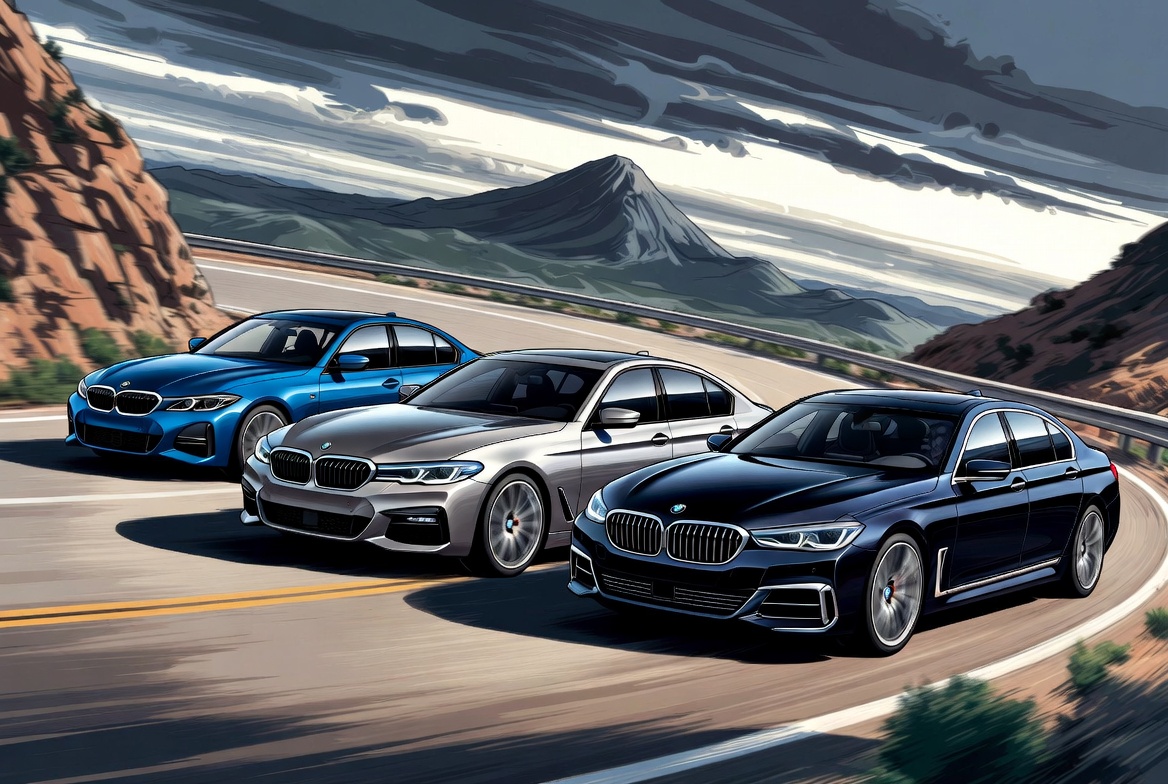
BMW G-Series: The Modern Era of Driving Pleasure
The letter "G" in BMW's internal nomenclature marks a new chapter in the brand's history. While earlier models used "E" (for Entwicklung, or development) and then "F" codes, the G-series began appearing around 2015–2018. These vehicles are built primarily on the innovative CLAR (Cluster Architecture) platform, which allows greater flexibility in combining rear-wheel drive, all-wheel drive (xDrive), gasoline, diesel, plug-in hybrid, and even fully electric powertrains.
The G-series covers almost the entire lineup: from the compact G20/G21 (7th-generation 3 Series, launched 2018–2019) to the luxurious G11/G12 (6th-generation 7 Series, 2015), the elegant G15/G14 8 Series, and the large SUVs like G05 X5, G07 X7, and G01 X3. Even high-performance M models received G codes: the aggressive G80 M3 and G82 M4 debuted in 2020–2021.
One of the most fascinating facts is the shift in design and technology. The G20 3 Series grew slightly in size and wheelbase compared to the F30, improving interior space and stability while maintaining BMW's legendary "ultimate driving machine" feel. It introduced advanced features like the latest iDrive systems, laser headlights (in higher trims), and a wider use of mild-hybrid technology for better efficiency. The M3 (G80) became a headline-grabber: for the first time, an M3 offered optional xDrive all-wheel drive alongside the classic rear-wheel-drive layout, and a manual transmission remained available on RWD versions — a rare choice in this segment.
Performance highlights are impressive. The G80 M3 Competition uses the S58 3.0-liter twin-turbo inline-six engine, producing up to 503 hp (in some markets even more in special editions). BMW M division reported record sales in recent years, with the M3 becoming one of the best-selling high-performance models ever — over 71,500 full M cars sold globally in one recent year alone, showing strong demand despite polarizing "beaver-tooth" grille designs.
Interesting trivia: G-series models are produced in multiple countries, including Germany (Dingolfing, Munich), Austria, China, the USA, and Thailand. The CLAR platform helped BMW reduce weight in key areas while increasing rigidity, contributing to sharper handling. The 8 Series (G15 coupe) revived a legend with a luxurious grand-tourer feel, while the X7 (G07) brought BMW into the full-size luxury SUV segment for the first time, competing directly with Range Rover and Mercedes GLS.
Today, the G-series is evolving toward electrification: we see plug-in hybrids in the 5 and 7 Series, and fully electric i-models sharing similar body styles. Yet the core philosophy remains — powerful engines, precise steering, and that unmistakable BMW driving joy. The G-era proves that even in the age of SUVs and EVs, enthusiasts still crave the thrill of a well-balanced sedan or coupe.
Whether you're a fan of the sporty 3 Series G20, the executive G30 5 Series, or the beastly M models, the G-series represents BMW at its most technologically advanced and dynamically capable.