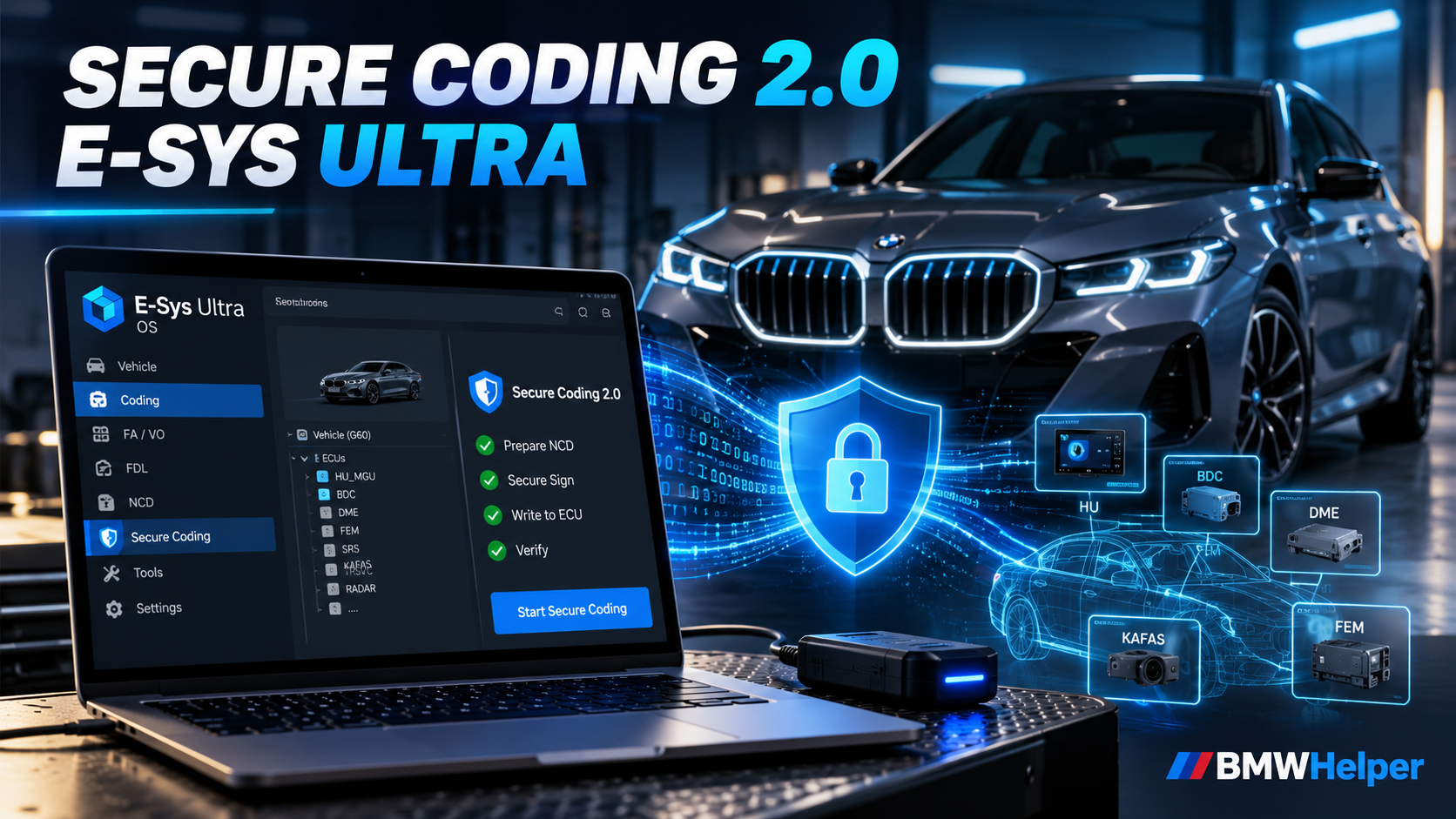
Secure Coding 2 Directly in E-Sys Ultra: A New Way to Code Modern BMWs
BMW coding has changed dramatically in recent years. With Secure Coding 2 protecting more electronic control units, even simple configuration changes can become challenging. But what if you could handle protected coding through the E-Sys Ultra ecosystem without relying on multiple separate tools? Let's explore E-Sys Ultra OS and why it matters for modern BMW owners.
BMW Coding Isn't What It Used to Be
If you've been working with BMW E-Sys for a while, you probably remember how straightforward coding used to be.
Connect to the vehicle, read the FA, select an ECU, modify the necessary parameters, and write the updated configuration.
A few minutes later, your changes were applied.
Unfortunately, things are no longer quite that simple.
Modern BMW vehicles feature increasingly sophisticated electronic systems, and many control units now use additional security mechanisms to protect their coding data.
Even when the configuration is prepared correctly, the ECU may reject it.
This is where BMW Secure Coding 2, commonly associated with NCD 2.0, comes into play.
What Exactly Is Secure Coding 2?
Secure Coding is a security mechanism designed to verify the authenticity and integrity of coding data before an electronic control unit accepts it.
In traditional BMW coding, E-Sys could often generate the necessary NCD data locally and write it directly to the ECU.
Protected control units may require an additional cryptographic signature.
Without valid signing information, the ECU can reject the coding operation even if the configuration itself is correct.
Not every BMW or ECU uses the same protection mechanism. Requirements depend on the vehicle platform, software version, and specific control unit.
For many modern BMW owners, this means that E-Sys and compatible PSdZData alone may no longer be enough.
Meet E-Sys Ultra OS
Here is something that many BMW enthusiasts may not know about yet.
The developers behind E-Sys Ultra offer E-Sys Ultra OS, a platform that includes services for working with protected BMW coding.
The idea is particularly interesting: bring Secure Coding-related functionality closer to the familiar E-Sys Ultra workflow.
Instead of searching for an external NCD signing provider and manually coordinating several tools, users can explore the signing services available through the E-Sys Ultra ecosystem.
For technicians and enthusiasts who regularly work with modern BMW vehicles, this can make a significant difference.
However, it is important to understand that access to a signing service does not automatically unlock every ECU or coding function.
Compatibility and available operations still depend on the specific vehicle and service capabilities.
How Does the Process Work?
Although the exact procedure depends on the software version and ECU, the general workflow can be described as follows:
- Connect to the BMW using E-Sys Ultra and read the current vehicle configuration.
- Prepare the required FA or supported ECU coding changes.
- Use the appropriate Secure Coding workflow to prepare the coding data.
- Obtain signed coding data when the operation is supported.
- Write the prepared configuration to the vehicle and verify the result.
The main benefit of an integrated solution is convenience.
Reducing the number of separate tools and manual file transfers can make the overall process easier to manage.
Exact menus, supported ECUs, and signing procedures should always be confirmed using the current E-Sys Ultra documentation.
Real-World Example: Coding an Imported BMW
Imagine purchasing a BMW originally built for the United States and importing it into Europe or another market.
You might want to adjust the vehicle's language configuration, regional settings, or other supported features.
On older BMW models, many of these changes could be completed through traditional FA or FDL coding.
On newer vehicles, some of the involved ECUs may require signed coding data.
This is where Secure Coding services become valuable.
With a supported workflow, it may be possible to prepare the required configuration and obtain the necessary signed data without relying on a completely separate coding environment.
Of course, coding signatures do not guarantee that every requested feature will become available.
Some functions also depend on vehicle hardware, software compatibility, regional restrictions, or licensing requirements.
Is Secure Coding Free?
This is an important question, especially for anyone planning to code multiple ECUs.
An E-Sys Ultra software license should not automatically be considered equivalent to unlimited Secure Coding requests.
Depending on the service, protected coding operations may involve separate charges, credits, or request-based billing.
Before starting, users should verify the current pricing, supported control units, and any applicable service conditions.
If a coding project involves several ECUs, understanding the cost structure in advance is particularly useful.
For the latest details, consult the official E-Sys Ultra OS platform.
Important Precautions Before Coding
Secure Coding 2 is not simply another checkbox in a coding application.
Protected ECU coding requires careful preparation.
Before making changes, save the original FA, SVT, and available coding data. Verify that your PSdZData is compatible with the vehicle's software level, and ensure that the vehicle has a stable power supply.
It is also essential to understand exactly which control units need to be coded.
Changing the configuration of a head unit or another major ECU can sometimes affect personalized settings or the availability of certain functions.
For this reason, avoid experimenting with random configuration changes simply to test a signing service.
A properly planned coding operation is always preferable to trial and error.
Why This Matters for the BMW Community
For years, enthusiasts have enjoyed the flexibility of BMW coding.
From adjusting convenience settings to configuring supported vehicle features, tools like E-Sys have become an important part of the BMW community.
Secure Coding introduced additional complexity, especially for owners of newer G-Series vehicles.
But software development has not stopped.
Solutions such as E-Sys Ultra OS demonstrate how coding tools continue to evolve alongside BMW's security architecture.
The protection mechanisms are still there, but access to compatible workflows is becoming more convenient.
For independent specialists and experienced enthusiasts, that is an encouraging development.
Where Can You Learn More?
To explore the available services, supported operations, and current conditions, visit the official E-Sys Ultra OS information page:
E-Sys Ultra OS: https://os.esysultra.com/info
If you are new to protected BMW coding, we also recommend reading our previous guide:
BMW Secure Coding 2: What It Is, Why It Exists, and How to Work With It
https://bmwhelper.com/news/bmw-secure-coding-2-what-it-is-why-it-exists-and-how-to-work-with-it
Final Thoughts
Modern BMW vehicles are becoming more advanced, and the tools used to configure them must evolve as well.
Secure Coding 2 has changed the way technicians and enthusiasts approach ECU coding, but it has not eliminated every possibility for customization and configuration.
With the right software, compatible equipment, and access to supported signing services, many coding tasks remain achievable.
E-Sys Ultra OS represents an interesting step toward a more convenient protected-coding workflow.
Have you already tried Secure Coding 2 with E-Sys Ultra? Share your experience with the BMWHelper community. We'd love to hear which BMW models and control units you've successfully coded.